On Making
Why Music Touches Us So Quickly – and Pictures Find It Hard
And how a line can do it too
There are moments in music when almost nothing is needed.
A note tips over.
A voice turns rough.
A harmony stays open a moment longer than we expected.
And suddenly something happens in the body.
The breath changes. The heart skips a beat. Perhaps tears rise.
We don’t yet understand what has happened. And still, something has reached us.
With pictures this happens to me less often.
Often the head starts working straight away.
What am I looking at?
How was it made?
What is it trying to tell me?
Is it representational or abstract?
Do I like it?
We categorise. We compare. We look for meaning.
Instead of being moved, we start to think.
And sometimes, in exactly that moment, something has already been lost.
What music does differently
Music doesn’t have to depict anything.
A note is not a tree.
A chord is not a landscape.
A pause doesn’t have to explain anything.
Music can work directly through rhythm, tension, volume, friction, repetition and silence.
And it reaches us physically. We can’t close our ears. Music carries us through time – through highs, lows, pauses and outbursts.
Perhaps that is where its great freedom lies.
We don’t have to understand a note before we respond to it.
The eye, by contrast, is an organ of orientation. It wants to put the world in order quickly: Is that a face? A tree? A danger?
That is why, with a picture, we want to recognise something quickly.
And even with a non-representational picture we often still look for something we can name.
So perhaps an interesting question is:
What happens if we think of a picture less as a depiction and more like music?
Not: What does it show?
But:
How does it sound?
Perhaps the answer doesn’t begin only when we look at a picture, but already in the way it comes into being.
Why pictures close themselves off
Music happens with us.
It begins, and we are right in the middle of it. It takes our time. We can’t listen faster than it plays.
A picture, on the other hand, waits.
It hangs quietly on the wall. We decide how long we look. A few seconds are enough to have “seen” it – and to move on.
In music we are inside.
In front of a picture we stand outside.
And this small distance changes a lot.
We have also learned to treat pictures differently from music. Nobody asks what a minor chord means. We let it work on us. In front of a picture, though, we read the label next to it. We ask what the artist meant. We want to understand it correctly.
With music, it may be a feeling.
With a picture, it is supposed to become an insight.
But the closedness doesn’t lie only with the viewer.
It often arises already while painting.
Whoever sings can’t hide. The voice shows how we are right now – in the very moment it sounds.
A picture, on the other hand, shows only the result in the end. The hesitating, the searching, the failing – we can paint over them. We can smooth, correct, improve, until nothing of us is left to see.
Often that is exactly what we do.
Because a picture that no longer risks anything protects.
It protects us from being seen. And it protects the viewer from feeling something.
Perhaps that is why so many pictures seem closed. Not because the picture as a medium can do less than music.
But because we take away the places where it would be allowed to break.
A line can have a sound
At first, a line is only a trace.
But it can be pressed or light.
It can come about quickly or hesitate.
It can come from the wrist or from the whole body.
It can break off.
It can repeat itself.
It can brace itself against another line.
Perhaps its effect lies less in what it depicts than in how it came about.
As with a voice.
A cleanly sung note doesn’t automatically touch us.
Sometimes it is precisely the slight breaking that touches. The breath. The roughness. The brief wavering.
Why should a line work any differently?
A stroke set down with determination, or with visible hesitation, carries that state onwards. We can retrace it in our own body.
Density needs emptiness
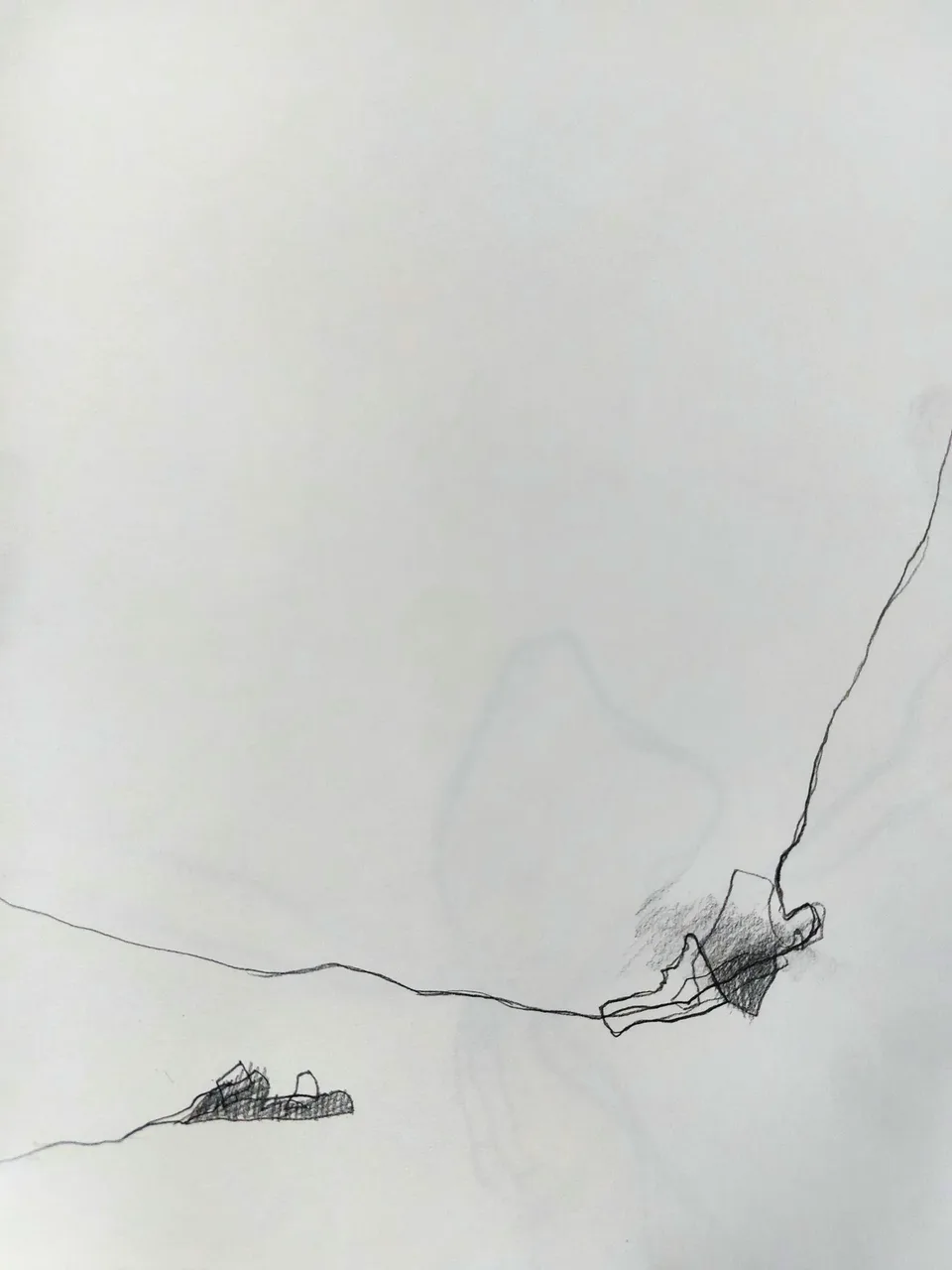
Music doesn’t consist only of notes.
It consists just as much of the spaces in between.
A pause changes what came before. And it changes what comes after.
A picture needs such spaces too.
When something is happening everywhere, each single thing loses its strength. A picture that is evenly attended to everywhere sounds like a loud, monotonous drone.
A dense, heavy spot only gains weight when something next to it is allowed to stay open.
A line can become loud because there is silence around it.
Perhaps the untouched surface is therefore not something that still has to be “filled”.
Perhaps it has long been part of the picture.
Pictures need resonance
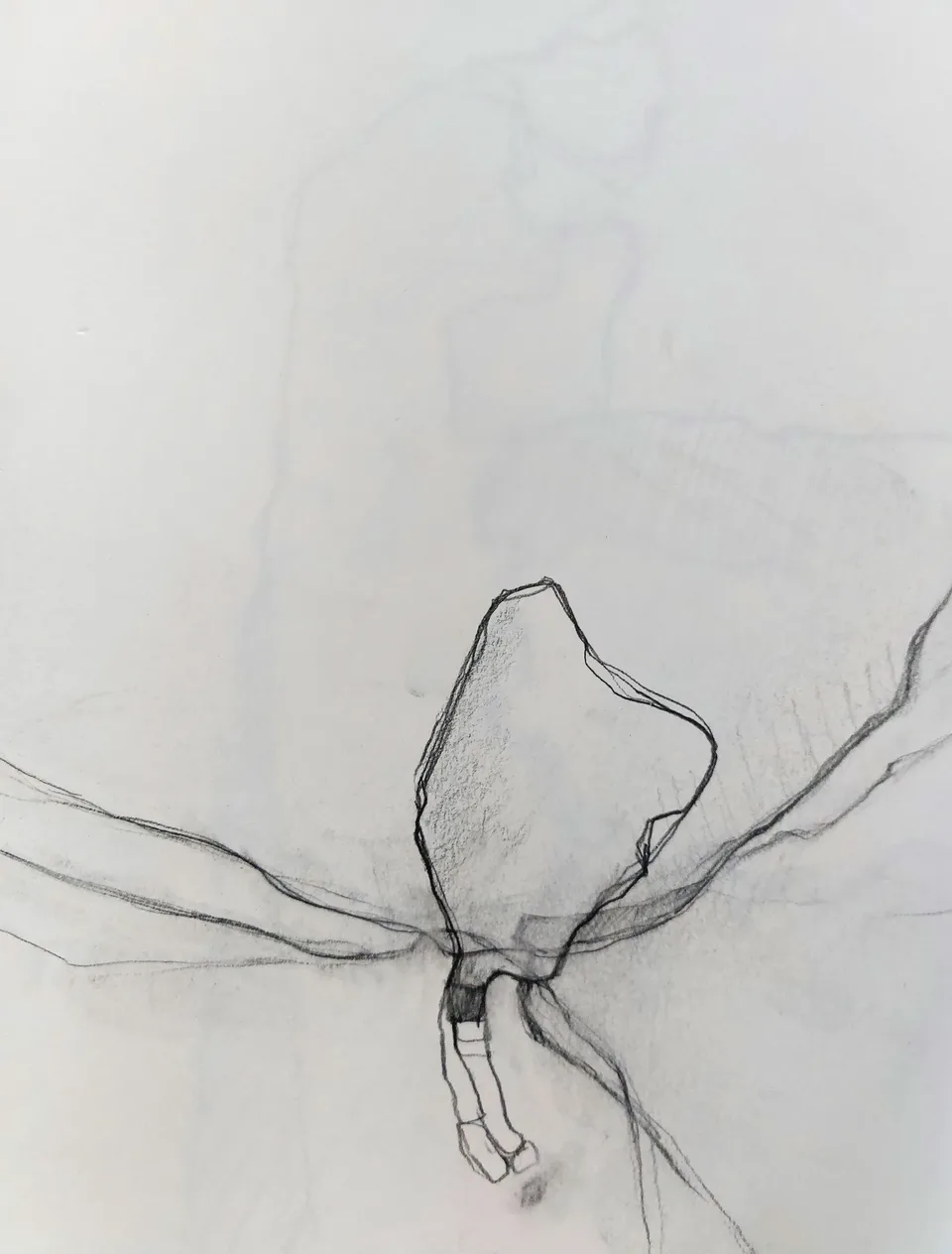
A single note fades quickly. It gains its depth through overtones and through the room in which it resonates.
When I draw and paint, I am more and more interested in what happens when a trace doesn’t simply stay as it is.
I layer over it.
I dissolve it again.
I scratch into it.
I smudge.
I take away.
I let something merely shine through.
Something was there and has now almost disappeared.
That is exactly how depth arises.
Not because the viewer has to know what was there before.
But because something of it is still in the picture.
Like a note that has long faded and still hangs in the room.
Not telling everything to the end
A fully explained picture leaves the person facing it little to do. It shuts the door.
Perhaps that is why there is so much strength in the unfinished.
A line ends suddenly.
A surface stays open.
Something appears and immediately slips away again.
We can’t hold on to it completely.
And that is exactly where the viewer begins to go on by themselves.
Not with the mind alone.
With memory. With the body. With feeling.
Then the picture doesn’t simply put something in front of us.
An encounter begins.
From making to letting it arise
Perhaps this is also where the difference lies between a picture we make and a picture we let become.
If I already know beforehand what the picture should look like, I work towards that result.
I correct.
I control.
I get the material to follow my idea.
If, instead, I perceive, respond and perceive again, the process changes.
Then a line can suggest something.
A surface can push back.
A chance mark can suddenly be more interesting than my original intention.
I still decide.
But I no longer determine everything.
The picture gains a weight of its own.
Perhaps that is exactly where a picture begins to come into being.
What does touching actually mean?
A picture can impress us.
That is something different.
Impressing happens at a distance. We admire the skill, the idea, the effect. And stay where we are.
Touching doesn’t happen at a distance.
It needs closeness. It needs a place where something is open.
And touching never goes in only one direction. We can’t touch anything without being touched ourselves.
In drawing, this is quite literally so.
The pencil touches the paper. The paper answers with resistance. The charcoal rubs off, the graphite gleams, the ink frays.
Every line is the trace of a touch.
And when we later stand in front of this trace, we can still feel the touch. The pressure. The tempo. The hesitation.
Perhaps that is the immediacy a picture can share with music.
Not what it shows.
But what happened while it came into being – and what wasn’t cleaned away.
Like the voice that briefly breaks.
Don’t make it pretty. Make it touch.
Don’t make it pretty doesn’t mean: make it ugly.
It means: don’t create distance. Don’t smooth what is allowed to stay open. Don’t clean away the place where the picture breaks.
The next time you stand in front of your sheet, don’t try to depict sadness, anger, calm or lightness.
That quickly leads to signs and symbols we already know.
Look instead for how something behaves. For the friction on the paper. For the pressure of the charcoal. For the gentle fraying of the ink.
How much pressure does this line need?
How fast does it want to be?
Where does the picture need resistance?
Where does it need calm?
What happens if you leave something that you would normally correct?
And what happens if you don’t know straight away where it is going?
Perhaps pictures don’t have to say so much at all.
Perhaps it is enough if something in them resonates.
Like a note that, for a moment, makes the heart dance.
Not because we have understood it.
But because it has reached us.
Try it out
Leaving emptiness, taking away, stopping in time – three sheets from the Picture Conversations for your drawing table:
Picture Conversation 04 – Much Space About Nothing · Picture Conversation 11 – Less Is More · Picture Conversation 13 – Quit While You’re Ahead?
Read on: When Is a Painting Finished?