On Making
The Material Responds
Why I stopped producing images
and started listening
For a long time I thought I had to learn to master the material. More control. More technique. More skill.
Today I ask a different question: What is the material actually ready for?
This question changes everything. I no longer paint against the material. I no longer try to make it submit to my ideas. I observe. How does water behave? How does pigment behave? How does paper behave? How does a surface change when it gives something of itself?
From properties to attitudes
Recently I was most interested in a technical contrast. Transparent or opaque. Fluid or compact. But the longer I worked with these ideas, the less they interested me. They describe properties. What interests me now are attitudes.
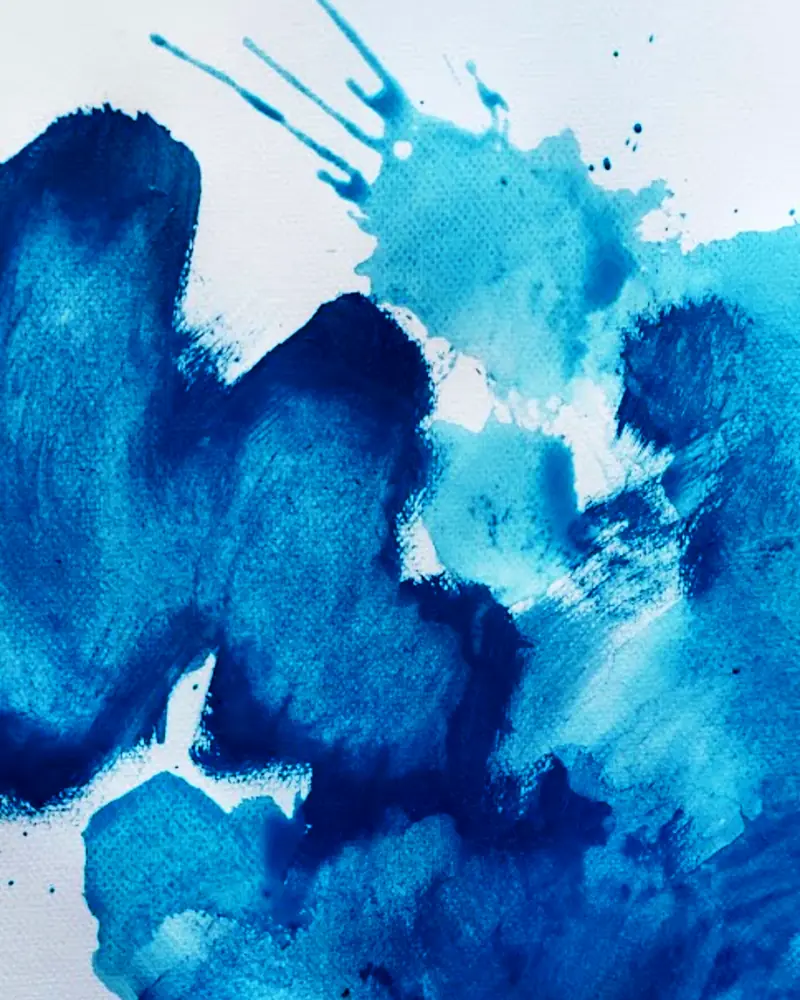
An opaque surface can be closed. It holds everything together. It gives nothing away. Another begins to open slowly. It lets water in. Pigments migrate. Contours lose their sharpness. Not because I force this. But because the material is ready for it.
Suddenly I am no longer painting contrasts. I am observing readiness. How much is a surface willing to give? How much does it hold back? When does it begin to respond? More on this — and why it also changes the question of when a painting ends — in When is a Painting Finished?
The material as mirror
The surprising thing: these questions are no longer only about colour. They are equally about us. We know these states too.
Holding on. Letting go. Resistance. Receptiveness. Condensation. Spreading.
Perhaps this is exactly why images move us. Not because they depict something. But because we recognise patterns of behaviour in them. A surface can be rigid. Another generous. A third cautious. A fourth seems to give itself away.
Investigating relationships
I notice more and more clearly: I am not investigating painting techniques. I am investigating relationships. Between water and pigment. Between surface and line. Between persistence and change. How binding media play a decisive role in this I have described in The Grammar of Materials.
The image emerges almost as a by-product. The real work is being attentive enough — not to ask: what do I want to make? But: what is the material responding to right now?
Perhaps art begins exactly there. Not making it beautiful. Making an encounter.